 Ribbonfinance
 withdrawals queued invested Theta V2 shares until their weekly round closed.
Ribbonfinance withdrawals used different routes for pending deposits and shares already invested in a weekly Theta V2 round. Pending deposits qualified for instant exits before rollover committed them to the strategy. Invested shares required a queued withdrawal and later completion, with the closed-round share price determining the collateral amount returned. Resumed positions could also qualify while their funds remained pending. Legacy Ribbon vaults halted after the December 2025 exploit, so those weekly rules describe historical operation and do not establish present recovery availability.
- updated
Bottom line: During normal Theta V2 operation, completing a queued withdrawal used its closed-round share price instead of later weekly returns.
Weekly Collateral Commitments and the Vault Halt
Collateral backing outstanding Theta V2 options remained committed while those positions stayed open. Opyn held the collateral supporting those positions. Burning unbought options could release unused collateral during a round. That release did not turn existing shares into a new pending deposit. An account's total interest could therefore exceed its immediately withdrawable balance. Exit availability depended on the account's investment state as well as the collateral available.
A pending balance offered a separate exit before its investment round began. Invested funds instead depended on the round's closing operations. The legacy vault halt following the December 2025 exploit changed that operating context. Another Friday did not, by itself, establish that a stopped vault could complete its former withdrawal process.
Which Funds Qualified for an Instant Withdrawal?
An instant Theta V2 withdrawal applied to funds still recorded as a pending deposit in the current round.
The relevant record was the account's
DepositReceipt
, which stored its deposit amount and round. Before rollover, that amount represented funds awaiting investment. Once the receipt belonged to an earlier round, the same deposit had passed into share accounting. It no longer qualified under the instant-withdrawal check.
A wallet could have older invested shares alongside a newer pending deposit. Only the newer eligible amount set the instant withdrawal limit. The requested asset amount had to be positive and no greater than the pending receipt amount. Older shares did not enlarge that allowance.
Recently resumed positions provided another documented entry into the pending state. Their instant eligibility depended on whether the resumed funds still awaited investment. Resumption did not create a permanent exemption from the round boundary. An account-wide balance display could conceal that difference.
A Partial Instant Exit Alongside Older Shares
A partial instant withdrawal could return pending ETH while leaving an older invested position in the vault. Consider a hypothetical pre-halt Theta V2 ETH position with a pending deposit of 3.72 ETH and older invested shares. The reader wants to withdraw 2.12 ETH.
The instant route qualified only if the pending receipt still belonged to the current round. Its 3.72 ETH amount covered the 2.12 ETH request. The older shares were irrelevant to this amount check because they represented a separate invested balance.
During normal operation, a successful
withdrawInstantly
call returned 2.12 ETH and reduced the pending receipt to 1.60 ETH. The calculation was 3.72 ETH minus 2.12 ETH. The older shares remained invested; the exit did not remove their exposure to the active strategy.
Completion meant that the transaction succeeded, the contract returned the requested ETH, and the pending amount decreased accordingly. If rollover had advanced the vault beyond the receipt's round, instant eligibility had ended. The balance then needed its applicable share-withdrawal route.
The Standard Queue and Its Share Units
A standard Theta V2 request queued vault shares, leaving their asset value to the round's closing calculation. The
initiateWithdraw
input was a share quantity. An asset-denominated amount copied from a balance display was not automatically the correct raw share input.
Initiation transferred the selected shares into vault custody and associated them with the account's withdrawal record. Their strategy exposure continued through the round in which the request entered the queue. The queue reserved an exit at rollover; it did not promise the original deposit amount.
Standard Theta V2 completion used the finalized collateral value per share for the queued round. A request fixed how many shares would exit. Option settlement, accumulated premiums, and applicable strategy fees could affect the eventual asset amount.
Further requests in the same round added shares to the existing queue. An outstanding request from an earlier round had to be completed before a new-round request could replace it. The account's withdrawal record could not combine unfinished requests from different rounds.
Friday Rollover and Actual Round Completion
Friday was the historical weekly rollover day, while contract state determined whether a standard withdrawal could finish. The calendar described the expected operating schedule. Completion required the queued withdrawal's recorded round to precede the vault's current round. That condition meant the relevant rollover had actually advanced its accounting.
The process also depended on expiry-price settlement and the operations surrounding the next option auction. Those dependencies made a single promised clock time misleading. An expired option, a closed position, and an advanced vault round were related milestones. They were not interchangeable completion signals.
The historical Ethereum workflow required a separate completion transaction after initiation. A withdrawal request created the queue entry; it did not itself send collateral back to the wallet. The account's closing round and finalized share price controlled the later transfer. Calendar time alone could not satisfy a contract that still recorded an unfinished round.
The historical SOL vault automatically returned wrapped SOL (wSOL) after withdrawal processing. Its users did not submit the separate completion transaction described for Ethereum.
Staked Shares and Resumed Positions
Staked or paused account positions needed their own release step before the ordinary withdrawal flow could proceed. Liquidity-mining staking placed vault shares in a staking contract. Unstaking returned access to those shares for the standard queue. It did not unwind the vault's active option position or eliminate the remaining investment-round exposure.
A paused personal position also differed from a protocol-wide vault halt. The historical account flow called for resumption before withdrawal. Recently resumed funds could qualify for instant exit while pending. Once those funds entered the next strategy round, the invested-share rules applied again.
Operationally paused or deprecated vaults added another constraint. The historical withdrawal guide allowed only standard withdrawals for these vaults and required project intervention. An account-level resume control could not establish that a discontinued vault had resumed its investment lifecycle.
Vault Tokens and Collateral Returns
Redeeming Theta V2 vault tokens transferred share custody to the account while keeping its underlying investment in place. The
redeem
and
maxRedeem
functions made owed ERC-20 vault shares transferable. Receiving those tokens established possession of shares, not receipt of collateral from a completed withdrawal. A wallet could therefore show vault tokens without a corresponding increase in its underlying asset balance.
Standard initiation could redeem owed shares internally before queueing them. A user therefore did not always need a separate preliminary redemption call. Staking, transferring shares, and withdrawing collateral were separate operations even when they referenced the same vault position.
Strategy Returns, Fees, and Reserved Assets
The queued exit amount reflected the strategy's net collateral value when its round finalized. An in-the-money option could reduce that collateral, while collected premiums contributed to returns. Queueing did not freeze the position at its original funding value. Covered-call and put-selling exposure remained relevant until the round settled, even after initiation.
The historical Theta fee terms described a 2% annualized management fee and a 10% performance fee. The fee guide described a charge on premiums in profitable weeks. The base V2 code calculated that charge on the round's net gain in collateral units. Management charges applied to managed assets during those profitable rounds. An unprofitable weekly strategy incurred neither charge under those terms.
Rollover deducted applicable fees before finalizing the share price and the amount reserved for exits. During normal Theta V2 rollover, the vault reserved queued withdrawal assets before allocating capital to the next option position. Already finalized withdrawals retained their own round's valuation rather than following each subsequent weekly return.
Reverts and Confirmed Asset Transfers
V2 withdrawal failures identified specific mismatches between the requested action and the account's recorded state. An instant call could fail because the receipt belonged to the wrong round or the request exceeded its amount. Standard completion rejected an absent queue or a queue whose round had not closed.
Successful standard completion cleared the queued share quantity, burned those shares, and transferred the calculated collateral to the account. Its
Withdraw
event recorded the account, asset amount, and share amount. A transaction signature or submitted request alone did not establish that those operations had succeeded.
The contract reverted if the calculated asset amount was zero. An interface display of zero did not change that condition. The contract's executed transfer determined whether collateral had actually returned to the account.
Pool Liquidity in Ribbon Lend
Ribbon Lend used pool utilization to limit exits, rather than the Theta V2 weekly share queue. Its historical design imposed no time lock on lending deposits. Withdrawals relied on funds available in the selected borrower pool. High utilization could limit the amount available despite a larger lending balance. Ribbon Lend paused until further notice; its earlier liquidity model did not establish present withdrawal access. A Theta rollover could not resolve a separate lending pool's liquidity constraint.
Ordinary Queue Deadlines and Recovery Claims
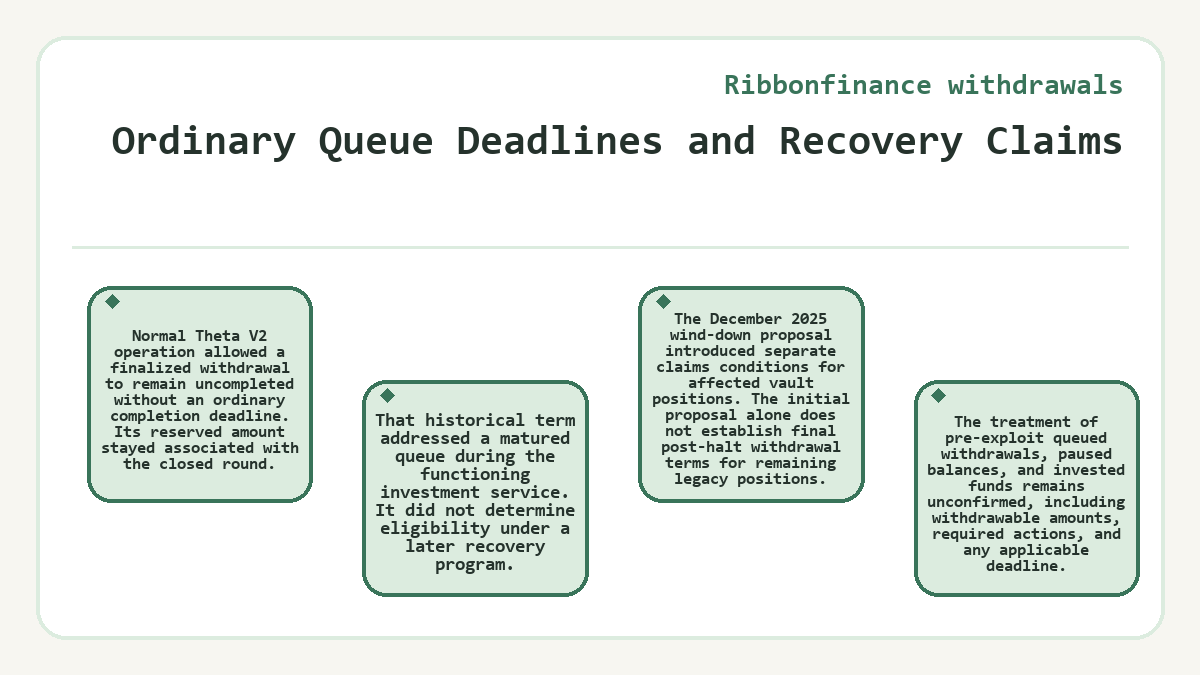
Normal Theta V2 operation allowed a finalized withdrawal to remain uncompleted without an ordinary completion deadline. Its reserved amount stayed associated with the closed round. That historical term addressed a matured queue during the functioning investment service. It did not determine eligibility under a later recovery program.
The December 2025 wind-down proposal introduced separate claims conditions for affected vault positions. The initial proposal alone does not establish final post-halt withdrawal terms for remaining legacy positions. The treatment of pre-exploit queued withdrawals, paused balances, and invested funds remains unconfirmed, including withdrawable amounts, required actions, and any applicable deadline.
Ribbonfinance withdrawals: questions and answers
Could I Cancel a Queued Theta V2 Withdrawal?
The historical Theta withdrawal interface did not allow cancellation after a standard request entered the queue. The queued shares therefore needed completion through the withdrawal flow. Increasing a request during the same round added shares; it did not reverse the original request.
Could a Full Theta V2 Deposit Cap Block Withdrawals?
A full deposit cap did not, by itself, block withdrawals in the historical base V2 implementation. Its cap check limited new deposits. Instant exits still needed an eligible pending amount, and standard exits still needed a valid queued claim whose round had closed.
Were Ethereum Withdrawal Transactions Free After an Unprofitable Vault Week?
Ethereum withdrawal transactions still required gas when the Theta strategy lost money. The historical fee waiver concerned vault management and performance charges. Network charges remained separate and depended on transaction execution and prevailing gas prices. An included transaction that reverted could consume gas without completing the withdrawal.
How Did Share Decimal Precision Affect a Theta V2 Withdrawal Amount?
V2 converted queued shares into collateral using the recorded share price and the vault's decimal scale. Integer division rounded any fractional smallest asset unit downward. Rounding could reduce the calculated payout by less than one smallest asset unit. A result that rounded to zero failed the positive-amount check.
Did Calling V2 Directly Through Etherscan Bypass the Withdrawal Queue?
A direct contract call enforced the same V2 eligibility checks as the corresponding withdrawal function used by the historical interface. Etherscan provided access to those functions; it did not change a deposit's round or turn invested shares into pending assets. Direct access did not make an unfinished standard queue immediately withdrawable.
Was Switching Vaults Part of Standard Withdrawal Completion?
The historical Theta interface required a withdrawal followed by a new deposit to switch vaults. That flow involved a minimum one-week pause before entry into the destination strategy. Completion returned collateral to the account; it did not itself open the replacement position.